IDF Curves
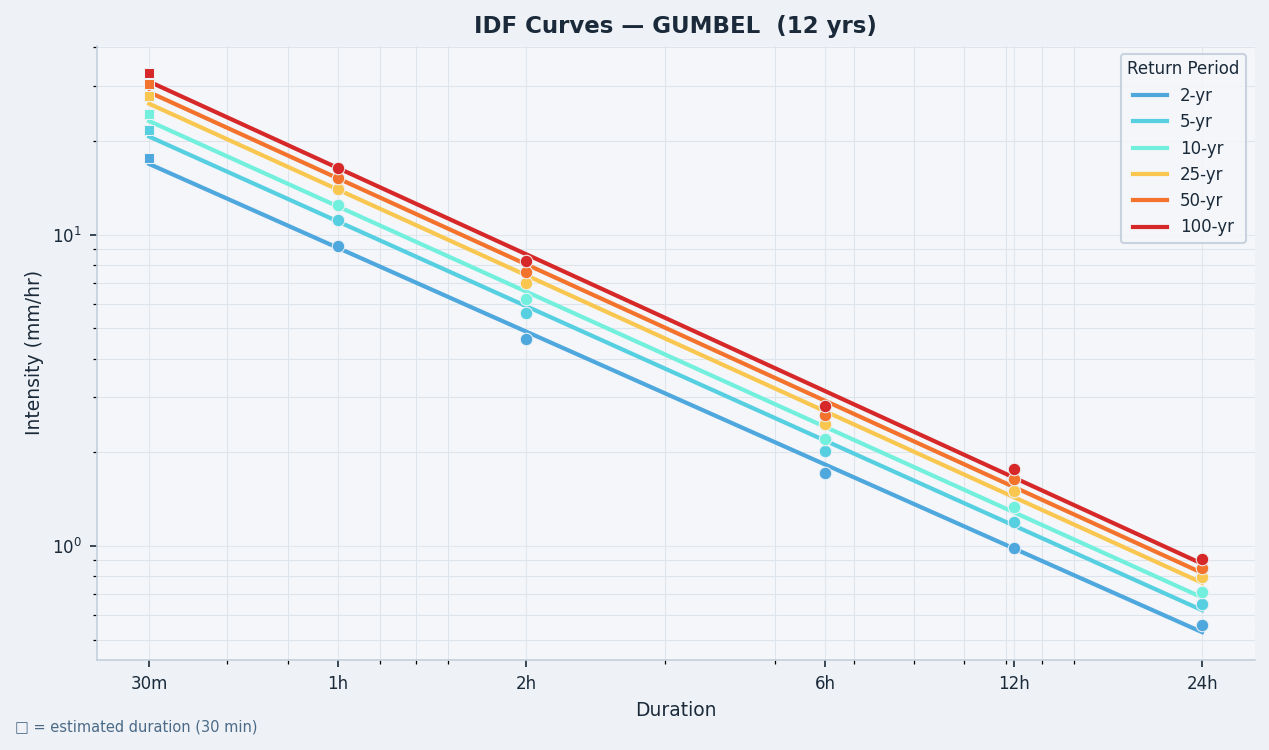
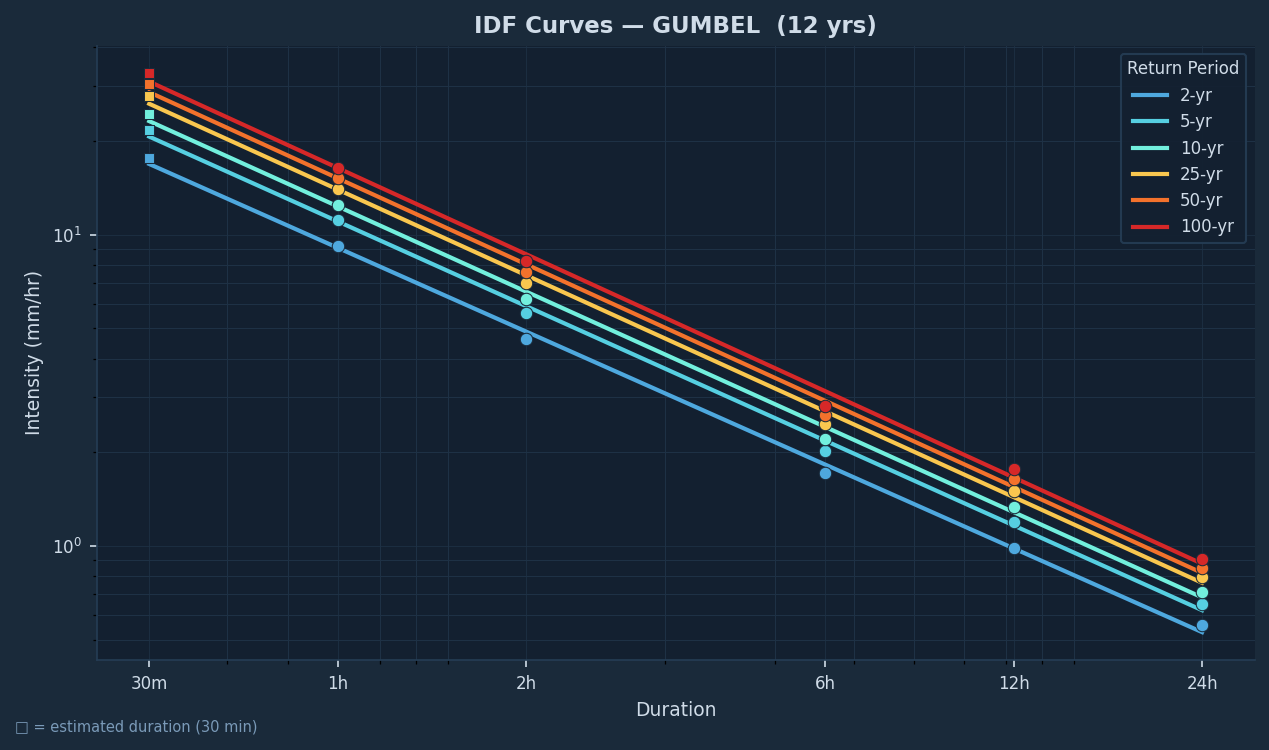
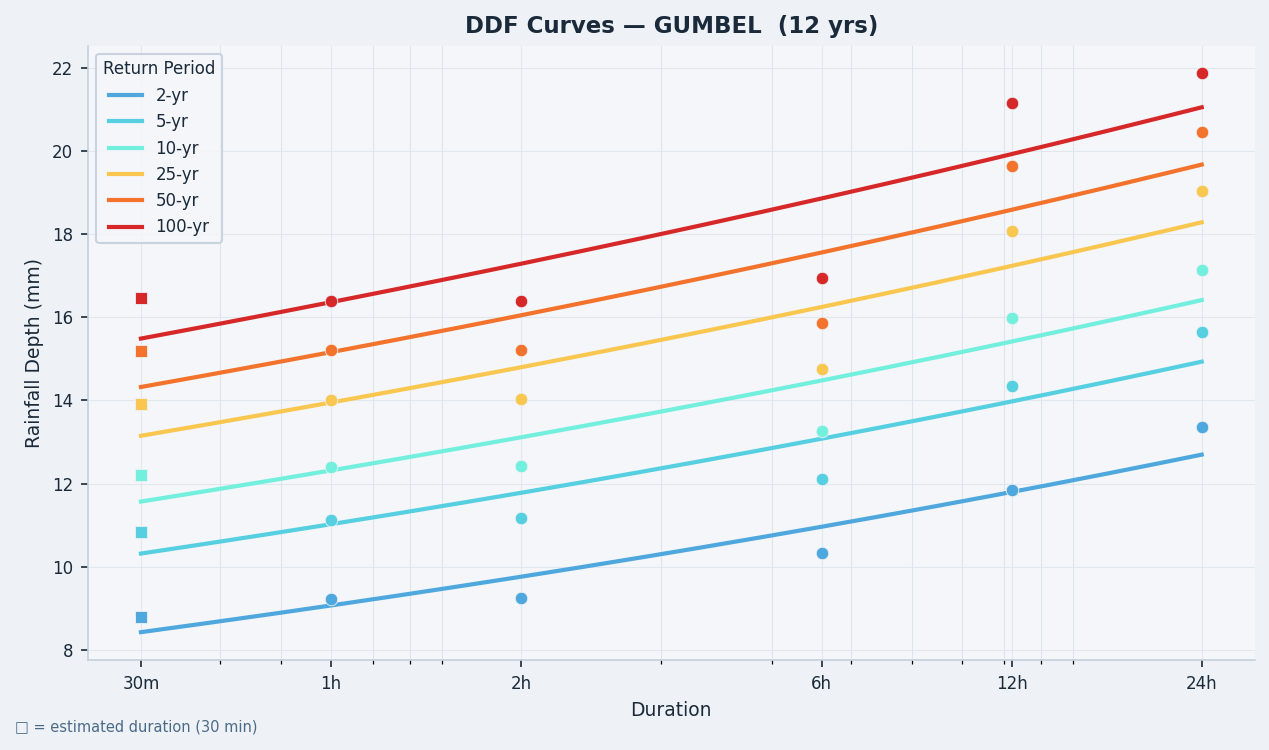
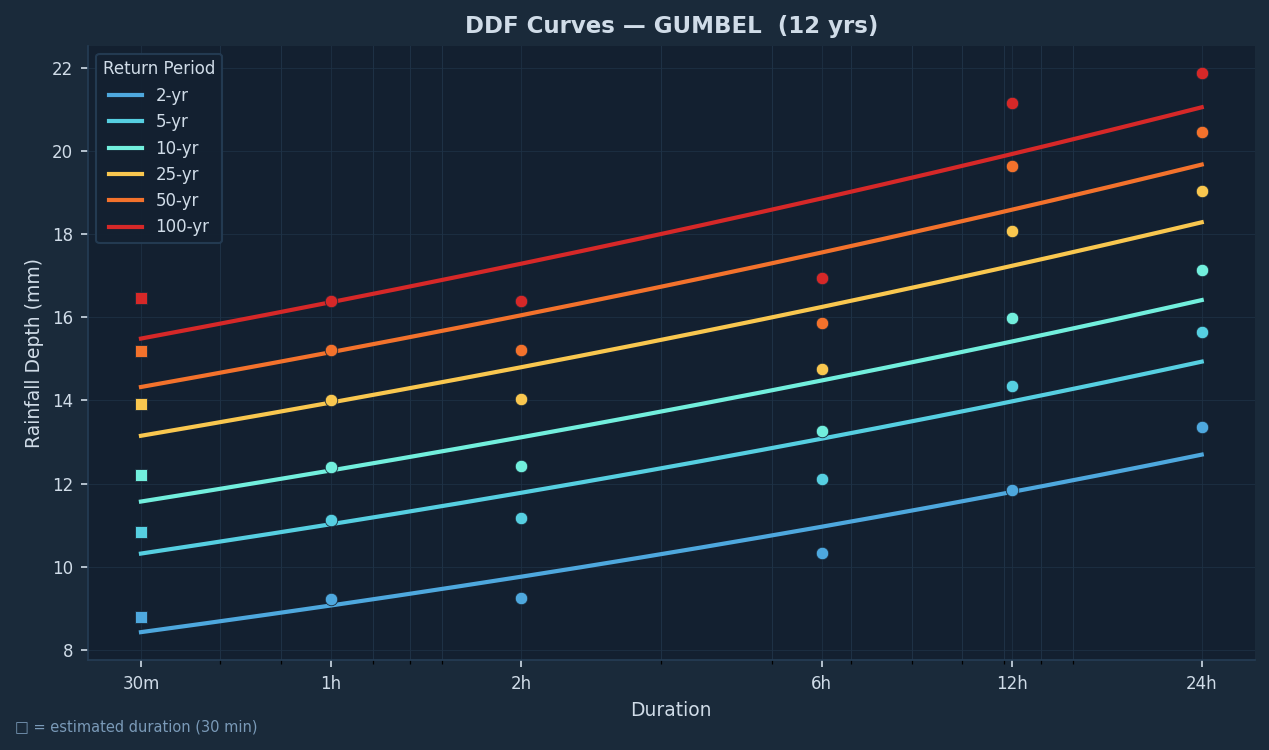
The IDF Curves tab assembles fitted Intensity–Duration–Frequency (and depth–duration–frequency) curves across durations, and builds design storms.
Controls
- Distribution — Gumbel (EV1), GEV, Log-Normal, or Pearson III — and Parameter estimation: Method of moments (the ECCC default), Maximum likelihood, or L-moments.
- View — IDF Curves, DDF Curves, or Intensity Heatmap.
- Options
- Show fitted curves — draw the smoothing curve through the per-duration quantile points.
- Curve form — Log-log linear (ECCC) or Sherman \(i = a/(d+b)^c\).
- Climate-change uplift — apply a percentage allowance to the final intensity/depth values (the historical fit is untouched and the uplift is disclosed in the title, report, and exports).
- Show 95% confidence intervals — bootstrap limits (with a Bootstrap samples count); markedly slower for GEV and Pearson III.
Screening
Like the Analysis tab, this tab has its own independent Completeness screening and Exclude outliers sections, and a Compare impact… button that renders the curves with and without screening. Outlier removal here applies to observed durations.
Outputs
Run from ▶ Run IDF (cancellable mid-run). The result toolbar offers:
- Pop out — open the plot in a resizable window for report sizing.
- Export tables… — Excel (intensity, depth, CI bands, and a metadata sheet) or CSV.
- Design storm… — generate a Chicago or alternating-block hyetograph (and SCS / NRCS distributions) from the fitted curves.
Notes
- The run log reports which durations are observed versus estimated. For daily-only records, sub-daily depths are estimated from ecozone depth ratios and are approximate — see Why sub-daily estimates are approximate and the ratio methodology.
- The ecozone used comes from the active location set on the Map tab.
- The curve-fit forms (log-log linear, Sherman) and the design-storm methods (Chicago, alternating-block, SCS / NRCS) are summarised, with their sources, in the Methods overview.
See also: Analysis · Methods & References