Methods overview
This page is a map of the analytical methods Cascade Hydro uses, grouped the way they appear in the application. It is a summary: the in-app Methods & References tab is the authoritative source, where each method is shown with its equations, its live data tables (the same values the code computes with), and its full citations. Numeric defaults and tabulated constants are deliberately not reproduced here, so this page cannot silently drift from the computation — read them live in the app.
Provenance is explicit in the app
Every method carries a provenance status. Where a value has no documented external source it is shown with a visible warning rather than presented as authoritative. A few methods (the climate-change uplift, the sub-daily estimation tiers) are user-driven or pending final sourcing and are marked accordingly in-app.
Frequency analysis & distribution fitting
The core of the tool fits an extreme-value distribution to a station's annual-maximum series and reads return levels from it.
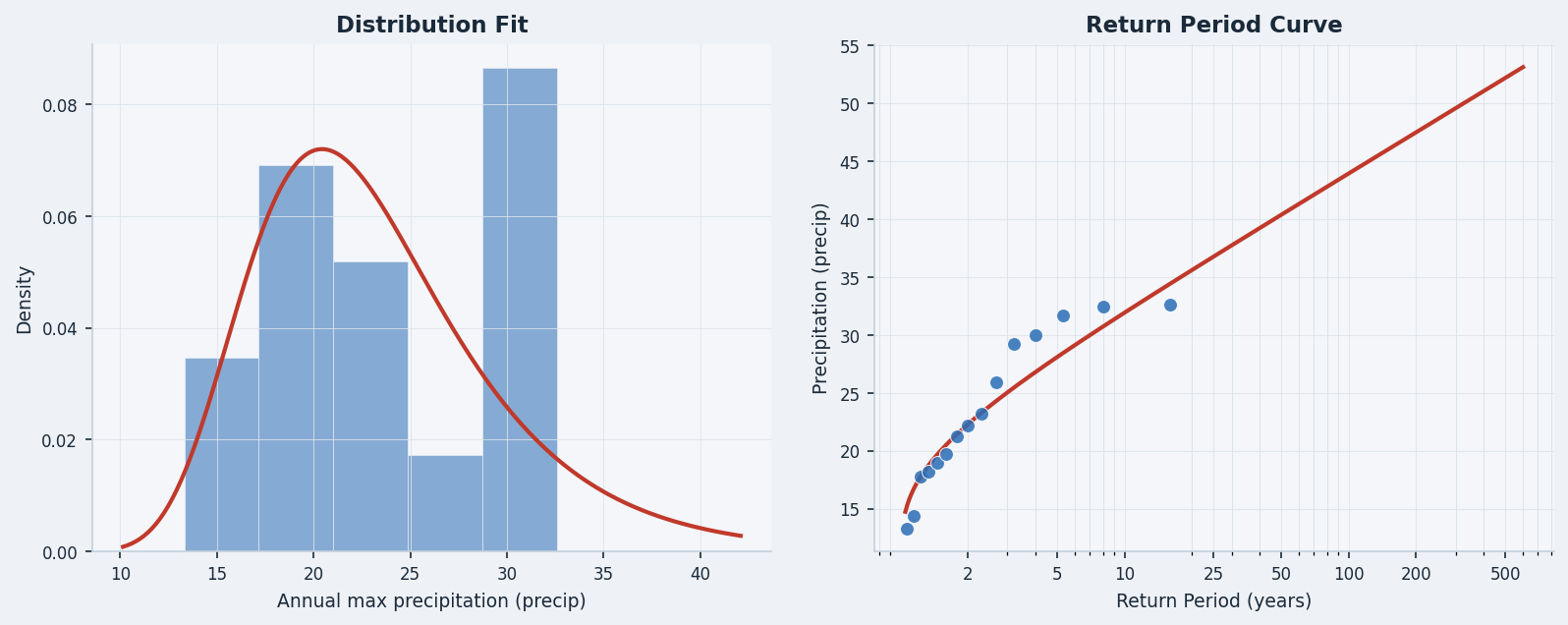
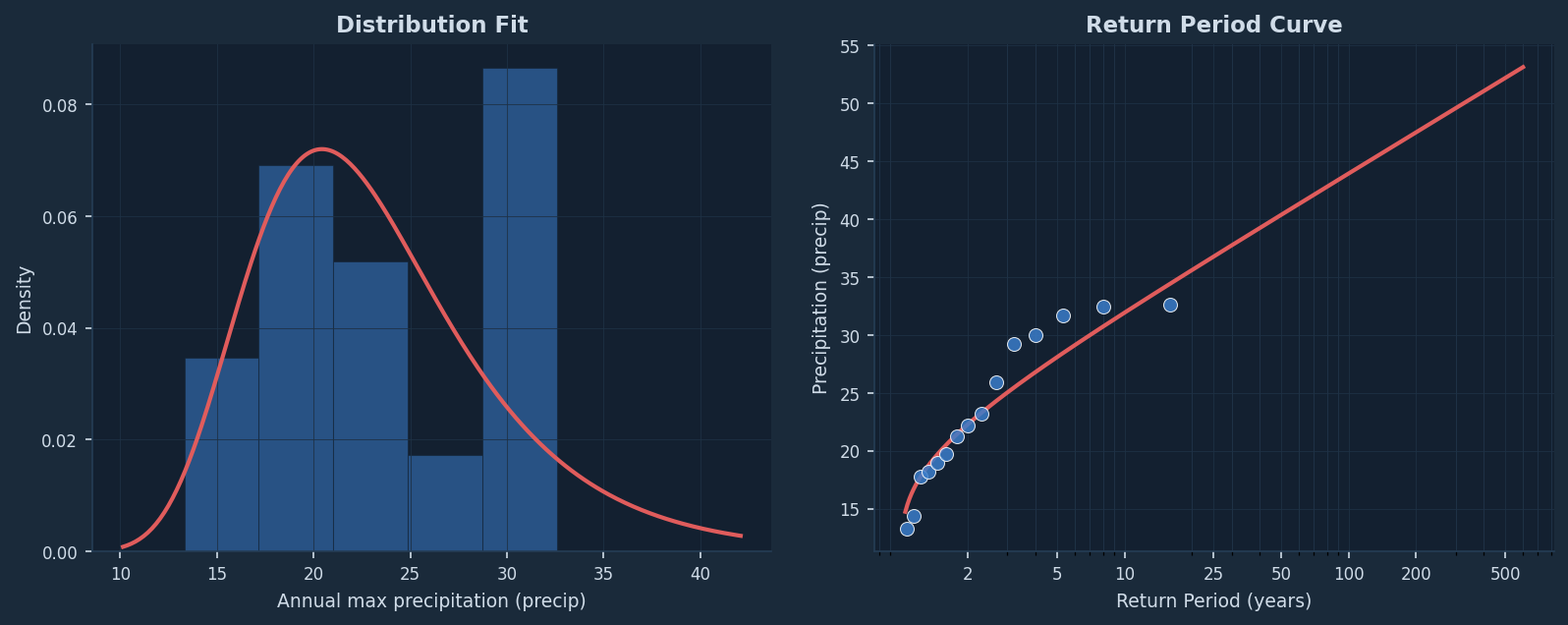
Candidate distributions
- Gumbel (EV Type I) — the default model for annual-maximum rainfall in Canadian/BC practice; ECCC's published IDF curves use a Gumbel fit. Gumbel (1958).
- Generalized Extreme Value (GEV) — three-parameter, with Gumbel as the shape → 0 limit. Jenkinson (1955); Hosking & Wallis (1997).
- Log-Normal — a standard right-skew model. Chow, Maidment & Mays (1988).
- Pearson Type III — its log-space form (log-Pearson III) is the U.S. Bulletin 17 standard for flood frequency. IACWD Bulletin 17B (1982); England et al., Bulletin 17C (2019).
Parameter estimators
- Method of Moments (MoM) — closed-form Gumbel estimators from the sample mean and standard deviation; matches ECCC practice. Falls back to MLE for non-Gumbel models (and says so).
- Maximum Likelihood (MLE) — iterative for GEV and Pearson III.
- L-moments (Hosking) — from probability-weighted moments; more robust than MoM/MLE for the short samples typical of annual-maxima series. Hosking (1990).
Supporting methods
- Weibull plotting positions — empirical exceedance probabilities for the observed-points overlay and the fit RMSE. Weibull (1939); reviewed by Cunnane (1978).
- Distribution ranking by AIC — the Akaike Information Criterion ranks candidate fits; lower is better, rewarding fit while penalising extra parameters. Akaike (1974).
- Confidence bands — a parametric bootstrap, re-fitting synthetic samples by the same estimator so the band is method-consistent. Efron & Tibshirani (1993).
IDF / DDF curves
- Curve construction — extract the annual-maximum series per standard duration, optionally screen incomplete years and outliers, fit the chosen distribution/estimator, evaluate at each return period, then fit a smooth curve across durations. A duration is fit only with enough years of record (ECCC produces curves for stations with sufficient record length).
- Return periods — a \(T\)-year event is the level with annual exceedance probability \(1/T\).
- Standard durations — a fixed set from 5 minutes to 24 hours, matching ECCC IDF practice.
- Curve forms — the default is an ECCC log-log linear fit, \(i = e^{\alpha}\, d^{\beta}\) per return period; the Sherman form \(i = a/(d+b)^{c}\) (Sherman 1931) is also available. \(R^2\) and RMSE are reported for each.
- Sub-daily depth ratios — for daily-only records, sub-daily depths are estimated by scaling the 24-hour maxima by region-specific ratios, \(\text{depth}(D) = \text{depth}(24\,\text{h}) \times \text{ratio}(D)\), with \(\text{ratio}(24\,\text{h}) = 1.00\) by definition. Ratios are keyed to ecozone rather than province because the sub-hourly-to-daily ratio follows storm regime (convective vs. synoptic), not administrative boundaries. See the sub-daily ratios overview and provenance for the method and confidence flags; the live per-region values are in the app's Methods & References tab.
- Estimation tiers — observed sub-daily maxima are preferred (Tier 1), then fitted-curve interpolation (Tier 2), then the daily-to-sub-daily ratio scaling (Tier 3); the applied tier is disclosed in the report.
- Climate-change uplift — an optional user-entered percentage applied to the final intensity/depth tables, disclosed in the report when non-zero. The basis for any specific value is the user's to cite.
Data quality & diagnostics
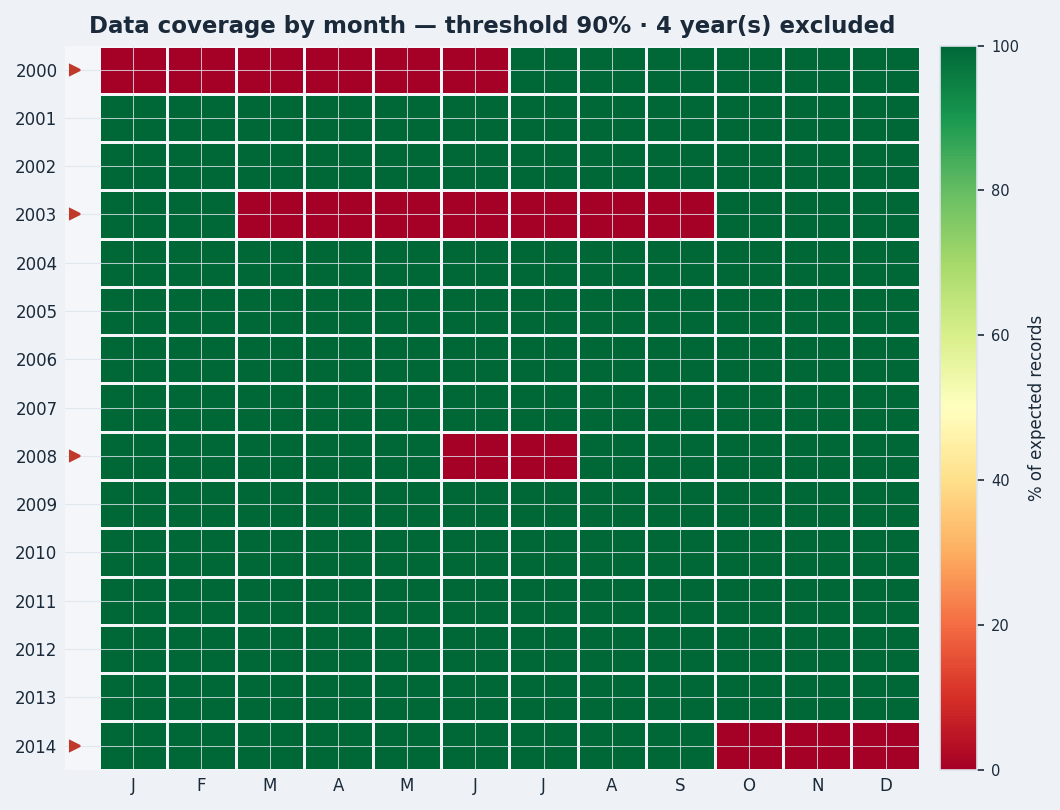
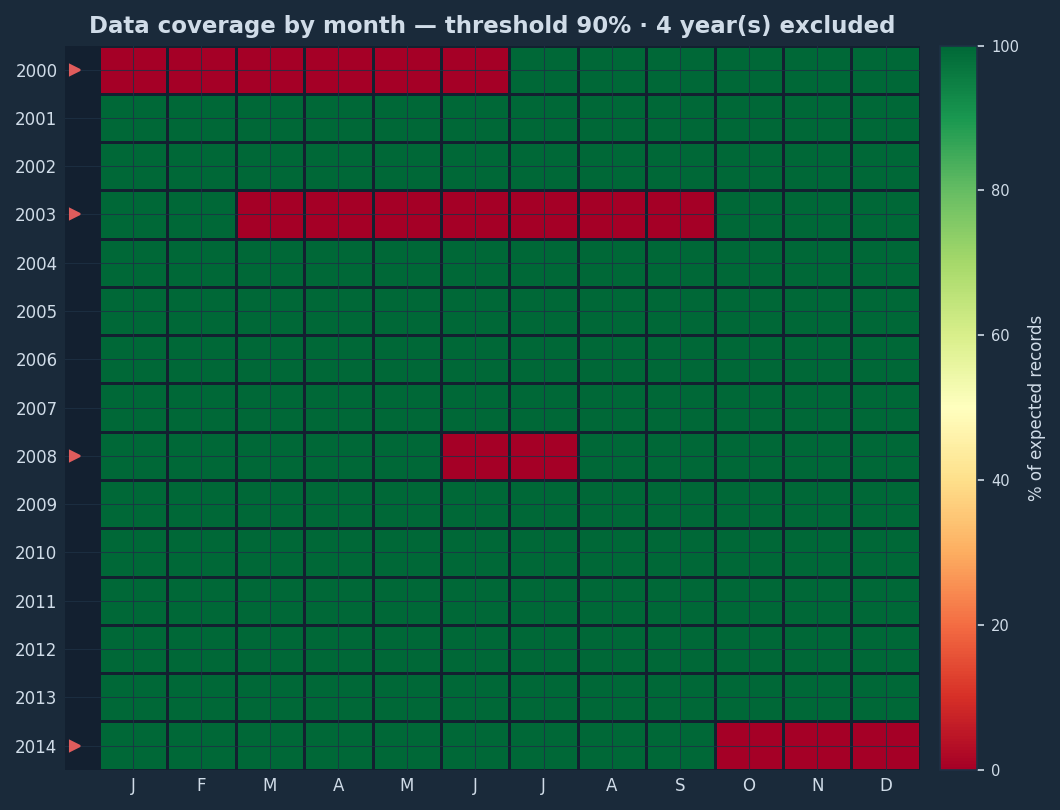
- Year-completeness screening — excludes insufficiently-complete calendar years before fitting, since a maximum from a partial year is biased low. The default threshold follows the WMO convention on allowable missing data (Guide to Climatological Practices, WMO-No. 100). Off by default; each tab screens independently.
- Record adequacy & reliability ceiling — translates the count of complete years into an effective record length and the return period beyond which estimates become extrapolation. Advisory; it does not alter any fit. Stedinger et al. (1993); WMO Guide to Hydrological Practices (WMO-No. 168).
- Compare impact — renders a result with and without the active screening side by side, summarising what changed. A transparency aid, not a new method.
- World-record rainfall envelope — a physical-plausibility ceiling approximating the WMO world-record point-rainfall observations; gauge readings near or above it are flagged for review. WMO-No. 168; Jennings (1950).
- Mann–Kendall trend test — non-parametric test for a monotonic trend, with Sen's slope for magnitude. Mann (1945); Kendall (1975); Sen (1968).
- Pettitt change-point test — non-parametric test for a single shift in the series. Pettitt (1979).
- Lag-1 autocorrelation — serial-dependence check against Anderson (1942) 95% bounds; dependence violates the independence assumption of frequency analysis.
- Gap & timestamp integrity — descriptive checks on detected resolution, missing intervals, and duplicate/irregular timestamps.
Outlier detection
- Grubbs test — detects the single most-extreme value; the statistical basis of the Bulletin 17B/17C high/low-outlier screen, computed on log-transformed data by default. Grubbs (1969).
- Modified Z-score (MAD) — a robust flag based on the median absolute deviation. Iglewicz & Hoaglin (1993).
- Log-space Z-score — a z-score in log space, suited to right-skewed rainfall maxima. Barnett & Lewis (1994).
Design storms
- Chicago design storm — a synthetic hyetograph from the IDF curve with a configurable peak position, discretized to the model timestep with mass conserved. Keifer & Chu (1957).
- Alternating-block — incremental depths from the IDF curve ranked and placed around a central peak; total depth conserved. Chow, Maidment & Mays (1988).
- SCS / NRCS 24-hour distributions — Type I / IA / II / III dimensionless mass curves applied to the 24-hour design depth, from the WinTR-55 tabular distributions. USDA-NRCS WinTR-55; SCS TR-55 (1986).
How this stays trustworthy
The analysis core is a pure-Python, headless-testable layer guarded by an independent-ground-truth test suite, and validated end-to-end against a published ECCC IDF dataset. See ECCC real-data validation for how closely the tool reproduces ECCC's own published curves, and the basis for monitoring drift over time.